
Irrigation scheduling without the manual guesswork: how Ostara makes it possible
Managing polytunnel irrigation across fragmented systems costs time, labour, and yield. Learn how Ostara enables remote crop monitoring, irrigation control, and automated scheduling into one platform.
Getting irrigation right is one of the highest-stakes jobs in a polytunnel.
Temperature a few degrees off costs you quality. But irrigation errors – too little water, or too much – can kill a crop outright, faster than growers have time to notice and respond.
And it’s one of the more manual jobs too.
Most polytunnel operations have some version of an irrigation system: substrate probes to monitor moisture, dripper lines to cover more ground at once, timer-controlled valves to relieve some of the manual labour.
But the substrate probes sit behind a login only the MD knows, the irrigation controls are out in tunnel four, and the timers run on a fixed schedule regardless of what conditions are doing – which means that if the weather shifts, it’s still on you to run around manually topping up.
You end up with a fragmented picture of what’s actually happening, and irrigation that's managed against average conditions rather than actual ones.
This article covers what genuinely responsive irrigation scheduling looks like – and how Ostara brings together the monitoring, control, and automation that makes it possible.
What optimal polytunnel irrigation actually looks like
Crop water needs aren’t fixed. It depends on the crop, the location, the weather conditions, and so on.
Which means the answer to ‘what’s optimal crop irrigation’ varies from day to day – or even from morning to afternoon, given that research on polytunnel-grown strawberries in coir recorded VPD swinging from 0 to 5 kPa within a single day.
So an irrigation schedule set for average conditions doesn't move with that.
Getting irrigation right requires four things working together:
- Monitoring: granular visibility across every relevant variable to understand when and how much water is needed – evapotranspiration (ET), vapour pressure deficit (VPD), substrate moisture top and bottom of the bag, run-off percentage per irrigation event, EC, pH, water temperature, PAR, weather.
- Control: the ability to act on what you're seeing quickly – adjusting shot volume, irrigation frequency, and timing across every valve and zone when needed.
- Automation: irrigation scheduling that responds to conditions and targets rather than a fixed programme set once and reviewed weekly – so you get precision without needing the manual labour to execute every response.
- Optimise: closing the loop by tracking what impact your irrigation schedules and amounts have on the variables you’re monitoring – so that you can refine and improve your irrigation approach over the time.
Where most polytunnel irrigation systems fall short
Most polytunnel operations have some of the components to achieve that ideal irrigation set up: substrate probes, a weather station, timer-controlled valves.
But they're fragmented.
Moisture data sits in one system, weather data in another, and the irrigation timer runs independently of both – dosing water at set times, without the context of current conditions or what the crop actually needs.
Errors quickly show up through disease outbreaks and poor harvest – and often this impact on yield is accepted as just part of the job.
But it doesn’t have to be. A 2020 trial at NIAB's East Malling Research Centre found a 7% yield uplift when irrigation was triggered by live substrate moisture sensors – watering based on actual crop needs rather than a set schedule.
And a 2025 review had even better outcomes, showing that adaptive scheduling based on real-time data can deliver water savings of 30-50% and yield increases of up to 20%.
How Ostara makes better irrigation scheduling possible
Replacing a fragmented, person-dependent irrigation setup with something the whole team can operate from one dashboard (for all tunnels) brings immediate time savings and yield improvements.
From there, once you’re ready to test out a more automated approach, Ostara also layers in VPD-driven and weather-responsive scheduling and continuous refinement over time.
Here's how each piece works together.
All the data that drives irrigation decisions, in one place – and proactive alerts when it matters
Ostara brings everything that should impact an irrigation decision into a single dashboard: substrate moisture, VPD, ET, EC, pH, water temperature, PAR, rainfall, weather forecast – no more fragmentation across separate logins and systems.
Each is tracked in real time, and surfaced as an easy-to-read graph.
Growers at the Bahrain Ministry of Agriculture incubation site, for instance, described having real-time access to data as a highlight of partnering with Ostara – being able to monitor and control their farm from anywhere in the world.
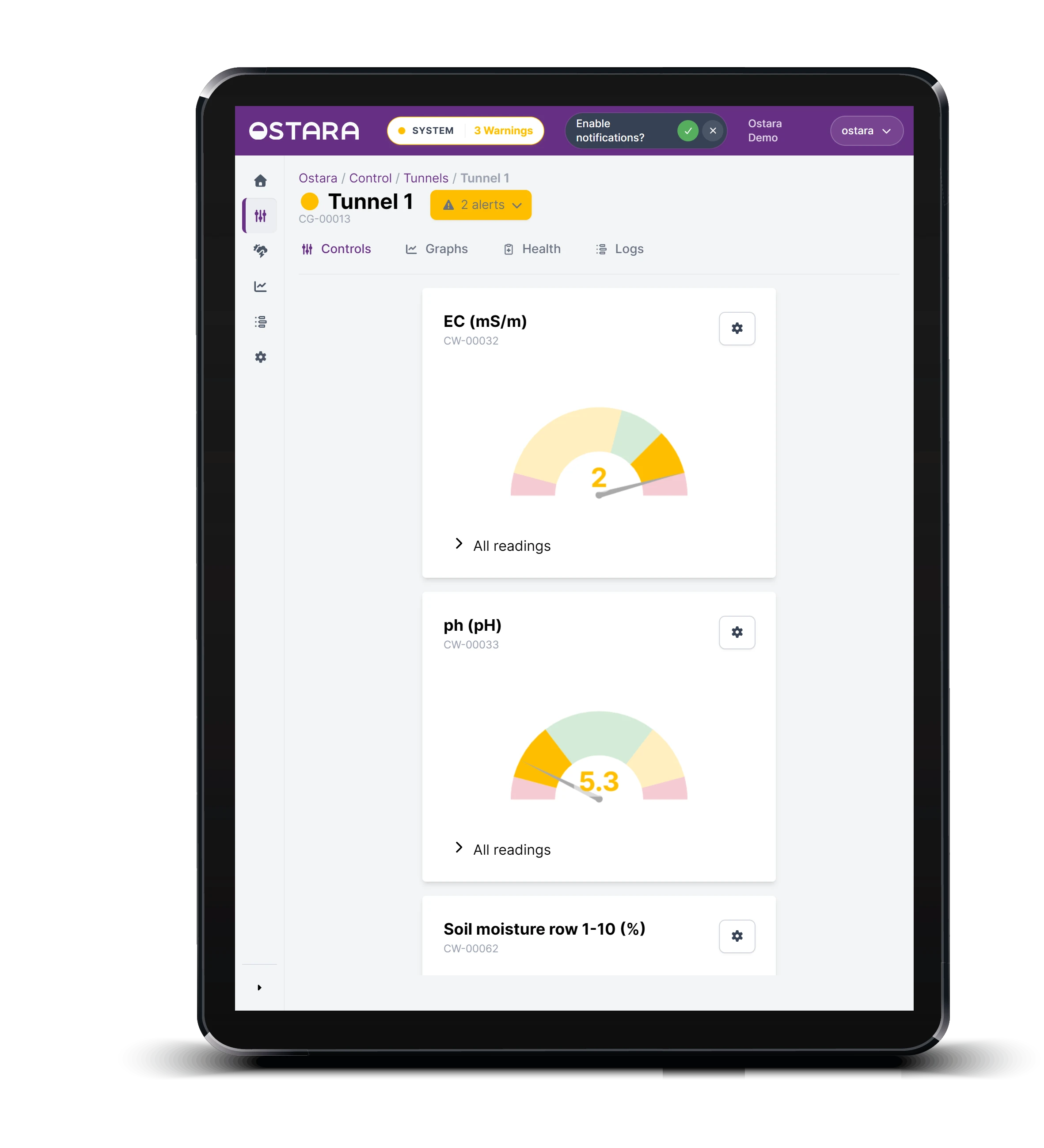
Change the time-frame (last day, last week, last month) to interrogate how your irrigation timing and shot volumes are actually impacting conditions, and make informed adjustments.
When something moves outside acceptable ranges, Ostara alerts you immediately of the irrigation risk – rather than you picking it up at the next manual check, when it might be too late.
Before Ostara: substrate moisture in one system, weather data in another, and no clear picture of what either is actually telling you to do.
After Ostara: one dashboard, real-time visibility across every variable, and an alert before the problem becomes a yield issue.
Full irrigation control, across every valve, from one dashboard
Ostara connects to your existing irrigation valves via TWL’s two wire irrigation decoders – a reliable system that can connect to up to 100 valves per unit.
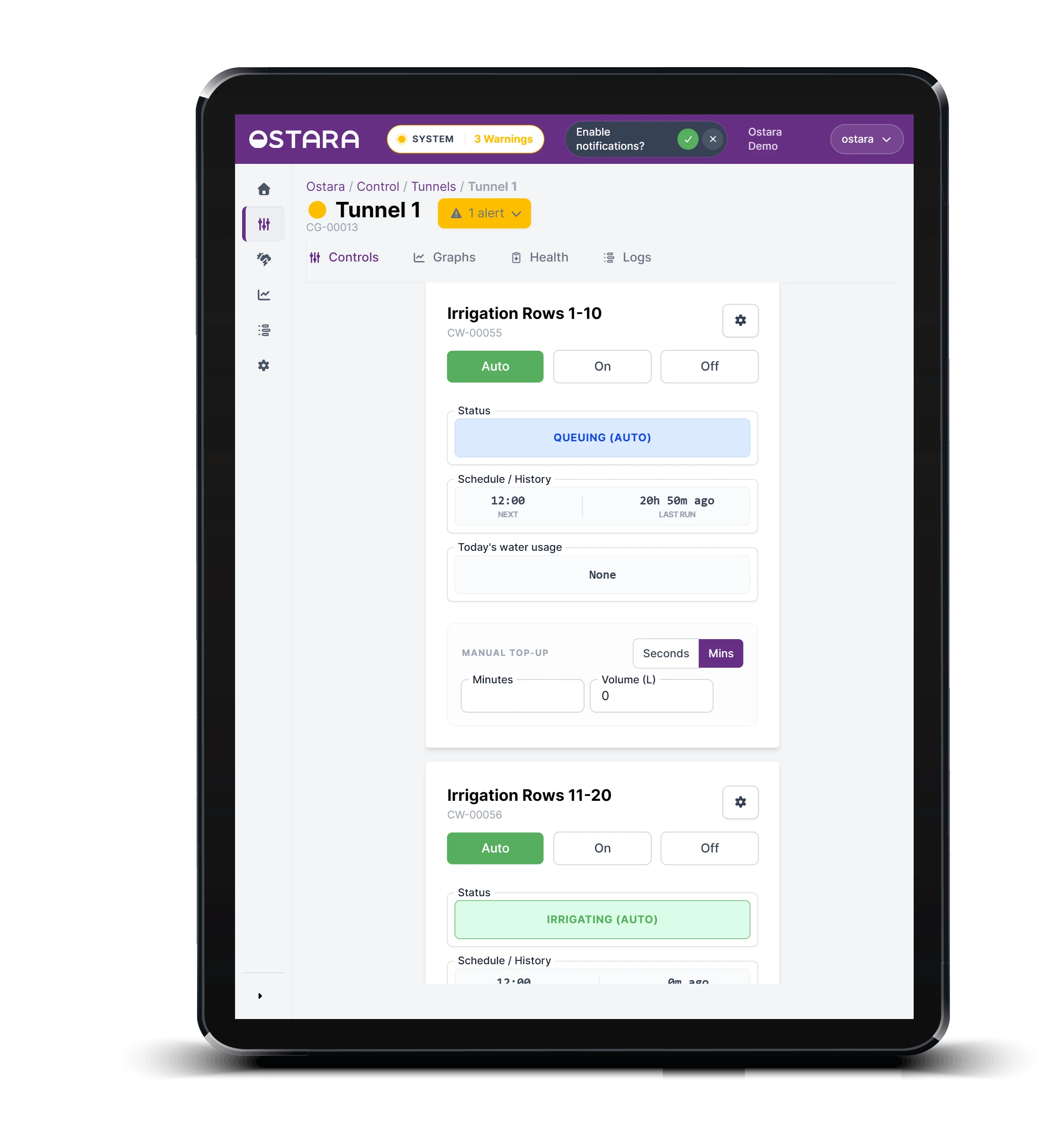
Once it’s set up, you can control every aspect of your irrigation programme through Ostara – scheduling, shot volume, frequency, manual top-ups when it’s hotter than expected.
The platform is organised to reflect how your unique farm layout actually works, so you can control irrigation by tunnel, by zone, by bay.
And, because it's the same platform as for your monitoring data, you're not switching between systems to see what's happening and act on it. You see VPD spiking in tunnel three and adjust the afternoon shot volume from wherever you are – or ask your team member to do it from their phone.
Before Ostara: the timer runs at 10am or 2pm regardless of conditions, and any adjustment to that means someone physically walking the tunnels to do it.
After Ostara: any member of the team can check conditions and adjust irrigation from their phone, at any time.
When you're ready, run irrigation to hit your targets automatically
Once you've built confidence in what the data is telling you, you can choose to hand the execution over to Ostara.
Set your targets, define your safety limits (irrigation frequency, water usage, etc), and the system delivers the irrigation needed to hit those targets continuously – adjusting intelligently based on actual crop needs, drawing from the granular monitoring data.
VPD is Ostara's primary automation trigger for irrigation – soil moisture readings are monitored, but we’ve found them too variable to use as a reliable control signal on their own (if you know of a reliable-every-time soil moisture sensor, let us know!)
You define what optimal looks like for your operation. Ostara delivers it.
Plus, the longer Ostara runs your irrigation, the more we learn. The system accumulates data on what's working – conditions, irrigation patterns, crop response – and Ostara's team of farm control experts reviews that with you over time, identifying opportunities to fine-tune your settings and get closer to optimal conditions.
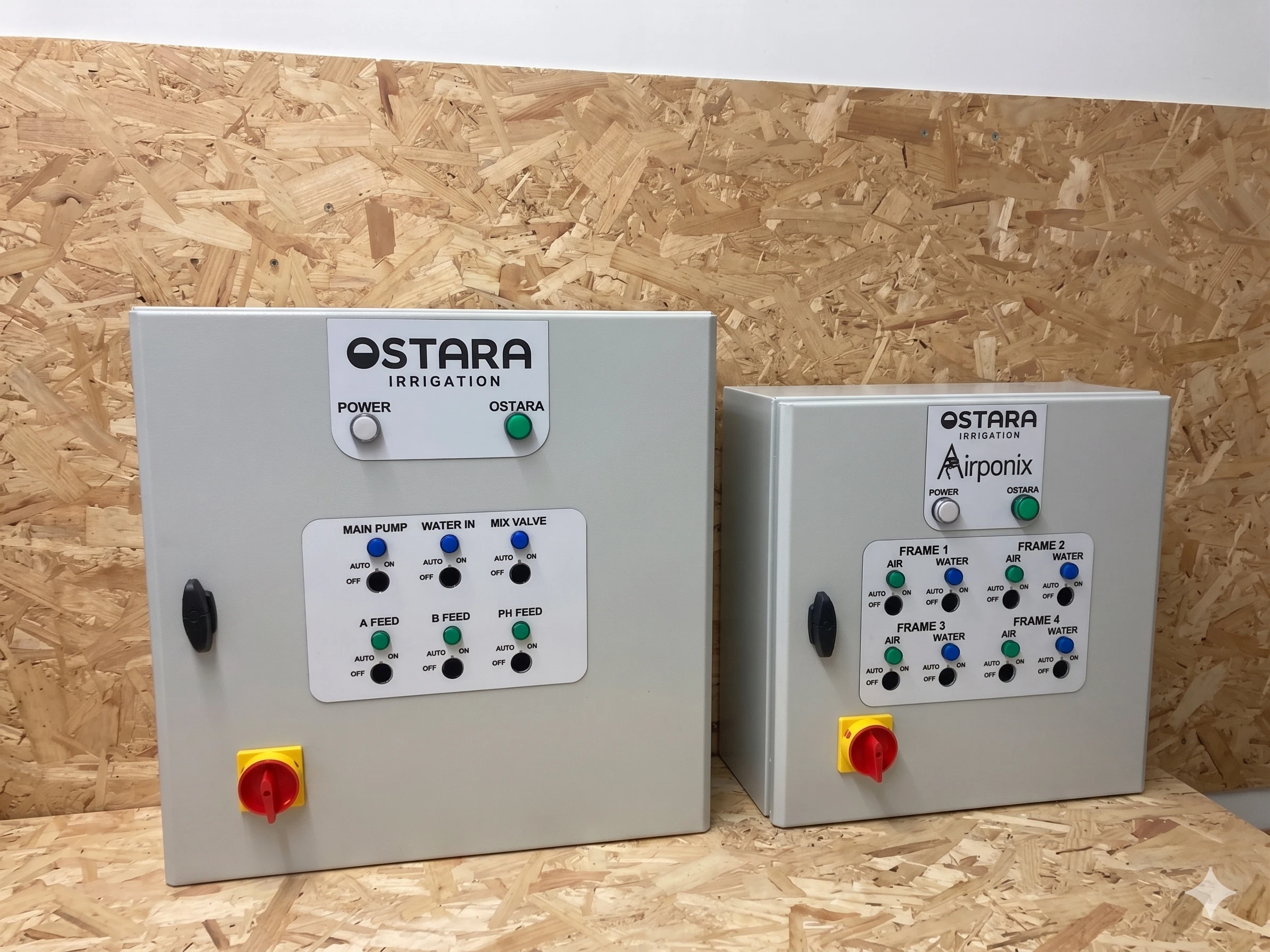
Manual override is always available. Switch from auto to manual with a single tap, or use the physical switches on the panel to bypass the software entirely if needed.
Before Ostara: the schedule is set once, reviewed when something goes wrong, and optimised by instinct.
After Ostara: your targets are set, the system executes them, and your irrigation approach gets sharper every season.
Weather-responsive irrigation scheduling
Ostara integrates weather forecast data via Open Meteo, feeding upcoming conditions into your irrigation scheduling ahead of time.
That means forecast evapotranspiration – the predicted water loss from crops and substrate across the day – feeds directly into how much irrigation is scheduled. A high-ET day tomorrow is accounted for today, and a forecasted 20mm of rain overnight adjusts the morning cycle before it runs, with no desperate scrambles to fix it later.
Before Ostara: weather conditions shift, but the irrigation timer doesn’t stop – it runs two cycles it shouldn’t have, and your crops are over-watered and at risk.
After Ostara: tomorrow's forecast is factored into irrigation scheduling – it’s smart automation that adjusts to actual crop conditions, not just a timer.
Works with your existing irrigation setup – no rip and replace needed
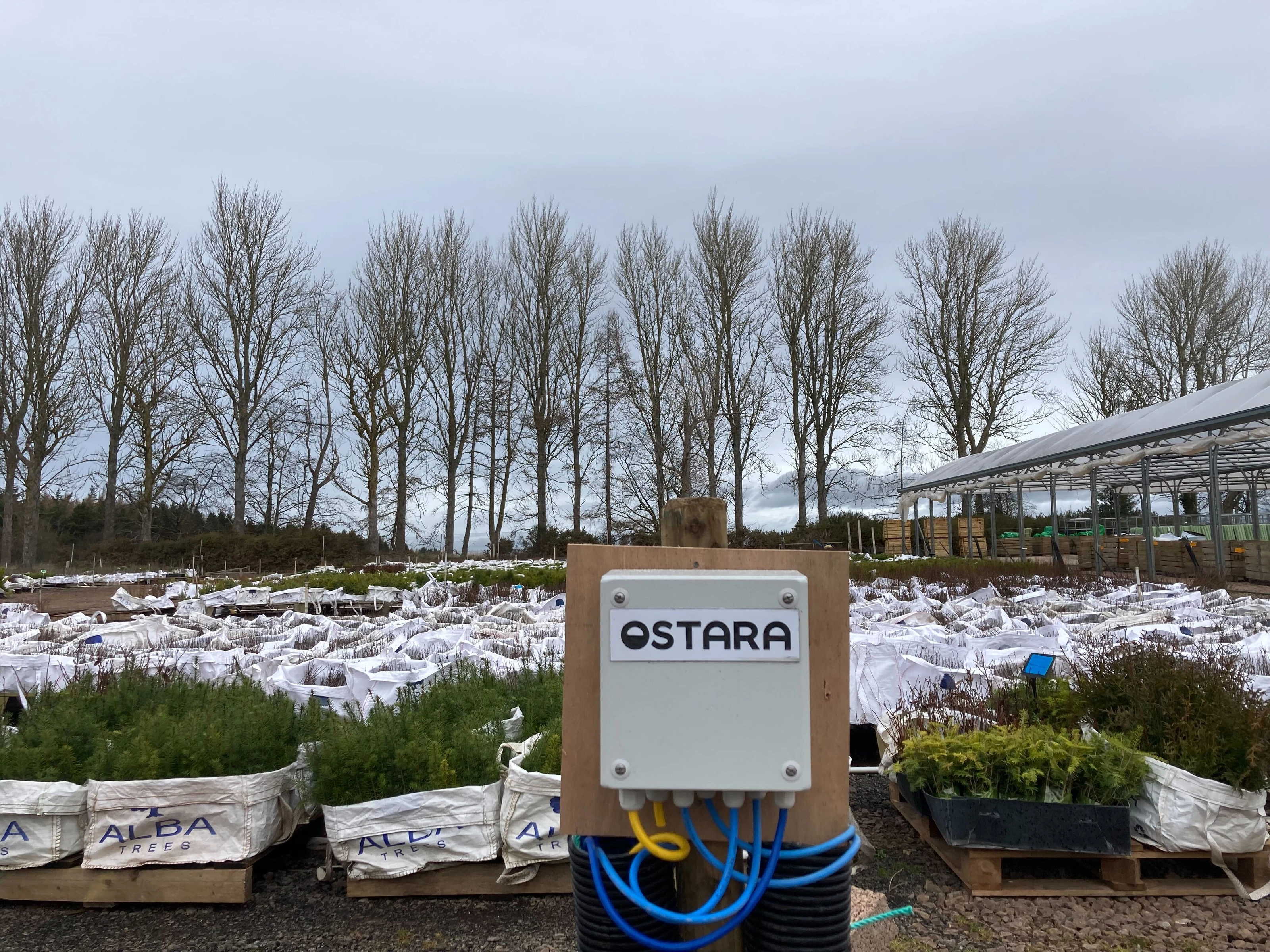
Ostara supplies an electrical panel that connects to your existing irrigation setup via TWL two-wire decoders. A single cable runs from the panel, with decoders attached along it, each one controlling a valve – your existing valves stay exactly as they are.
There’s no replacing functional equipment to add automation, no large upfront hardware costs.
Setup is straightforward, and the Ostara team handles installation and configuration with you, so you're not left figuring it out alone.
Once it's running, any electrician can support it, because the system uses standard components – and the Ostara team is on hand for any issues you encounter on the software side.
Before Ostara: automation means starting from scratch with a new system.
After Ostara: the infrastructure you've already invested in is connected, monitored, and controllable from anywhere, anytime.
Ostara doesn’t just control irrigation – bring all climate variables into one platform
Irrigation decisions don't happen in isolation. VPD, temperature, fertigation – they each affect what a crop needs to thrive in a polytunnel environment, and what optimal irrigation actually looks like on any given day.
Managing them across separate tools means you're always making irrigation decisions without the full picture.
Ostara covers the complete polytunnel climate control stack – irrigation, vent management, temperature, humidity, fertigation – all configurable in the same dashboard.
At the Bahrain Ministry of Agriculture site, for instance, Ostara connected and controlled both the irrigation and fertigation network from the same platform. Whereas for Haygrove’s trials, the focus was on vent management.
So when VPD spikes and you need to adjust both vents and irrigation frequency, you're doing it in one place rather than across three systems. Or, even better, the system handles those adjustments for you without you lifting a finger.
Wrapping up: Recover the yield your irrigation timer is costing you
Catastrophic irrigation failures are obvious: the crop that didn't survive the heatwave, the mould outbreak after a week of overwatering.
What's harder to see is everything in between – the yield and quality quietly lost to an irrigation schedule that was almost right, most of the time.
Ostara brings together the monitoring data that currently sits across separate systems, connects it directly to your irrigation controls, and lets you set the targets while the system executes – so irrigation responds to what the crop actually needs, not what a schedule set last month assumed it would.
The result is that yield losses which were previously invisible start showing up as yield recovered.
"Ostara enables me to make faster decisions, save valuable time, keep crops healthy and helps drive productivity and sustainability across every hectare." – Freddy Cavieres, Haygrove
If you'd like to understand how Ostara would work for your specific operation, get in touch with the team.
FAQs
What is an irrigation schedule?
An irrigation schedule defines when, how often, and for how long water is delivered to crops. In commercial polytunnel operations, this typically means a series of timed valve openings throughout the day, set by zone or by crop type, with shot volume and frequency adjusted for growth stage and conditions. The goal is to match water delivery to actual crop demand rather than running a fixed programme regardless of what conditions are doing.
What is an automated irrigation system?
An automated irrigation system replaces manual valve operation with software-controlled scheduling – opening and closing valves at set times, for set durations, without requiring someone to be on-site. More advanced systems go further, adjusting schedules in response to live data: VPD, weather forecasts, evapotranspiration rates, and substrate conditions.
What are the disadvantages of a smart irrigation system?
The main downsides of automated irrigation systems are upfront cost, setup complexity, and the risk of over-relying on a fixed schedule if the system isn't connected to live environmental data. A smart system that runs on timers alone (without responding to actual conditions) can still over or underwater crops when weather shifts. The other common issue is fragmentation: monitoring data in one platform, irrigation controls in another, with no connection between them. A well-integrated system addresses both problems, but not all smart irrigation products do.
Is automatic irrigation worth it?
Yes: the labour savings alone typically justify the investment. Research at NIAB's East Malling Research Centre found a 7% yield uplift when irrigation was triggered by live sensor data rather than managed manually, and a 2025 review found adaptive scheduling can deliver water savings of 30-50% and yield increases of up to 20%. The payback case is strongest when the system connects monitoring data to control.
Which irrigation system is best for polytunnel operations?
The best irrigation management system for a commercial polytunnel operation is one built specifically for that environment – not adapted from glasshouse or outdoor agriculture. Key things to look for: compatibility with existing valve infrastructure, remote control across multiple zones, live monitoring data in the same platform as the controls, and weather forecast integration so scheduling adjusts ahead of conditions rather than after. Ostara is purpose-built for commercial polytunnel operations and covers all of these.
Can I automate irrigation in an existing polytunnel without replacing my existing setup?
Yes. Systems like Ostara connect to your existing irrigation valves via TWL two-wire decoders, meaning your existing infrastructure stays in place. The Ostara electrical panel handles the connection between the software and your existing valves – no rip and replace needed, and no specialist hardware required for servicing.
Can I control irrigation remotely without being on site?
Yes – any irrigation platform with a software control layer should allow remote management via phone or laptop. With Ostara, for instance, you can check live conditions, adjust schedules, change shot volumes, and trigger manual top-ups from anywhere.
How do I get my irrigation system to respond to weather forecasts automatically?
You need an irrigation platform with weather forecast integration built in. Ostara, for instance, integrates forecast data via Open Meteo, which pulls from official forecasting services and provides granular hourly and daily predictions including evapotranspiration totals. Upcoming conditions feed into scheduling decisions ahead of time – so a hot, high-ET day tomorrow adjusts today's programme, rather than the grower scrambling to respond after the fact.
What's the best way to manage irrigation across multiple polytunnel zones?
The most effective approach is a centralised control platform that lets you set and adjust scheduling per zone from one dashboard, rather than managing separate timers or controllers for each tunnel or bay. Ostara, for instance, organises controls to reflect your farm layout, so you can manage by tunnel, by zone, or by bay, with the same interface across all of them.