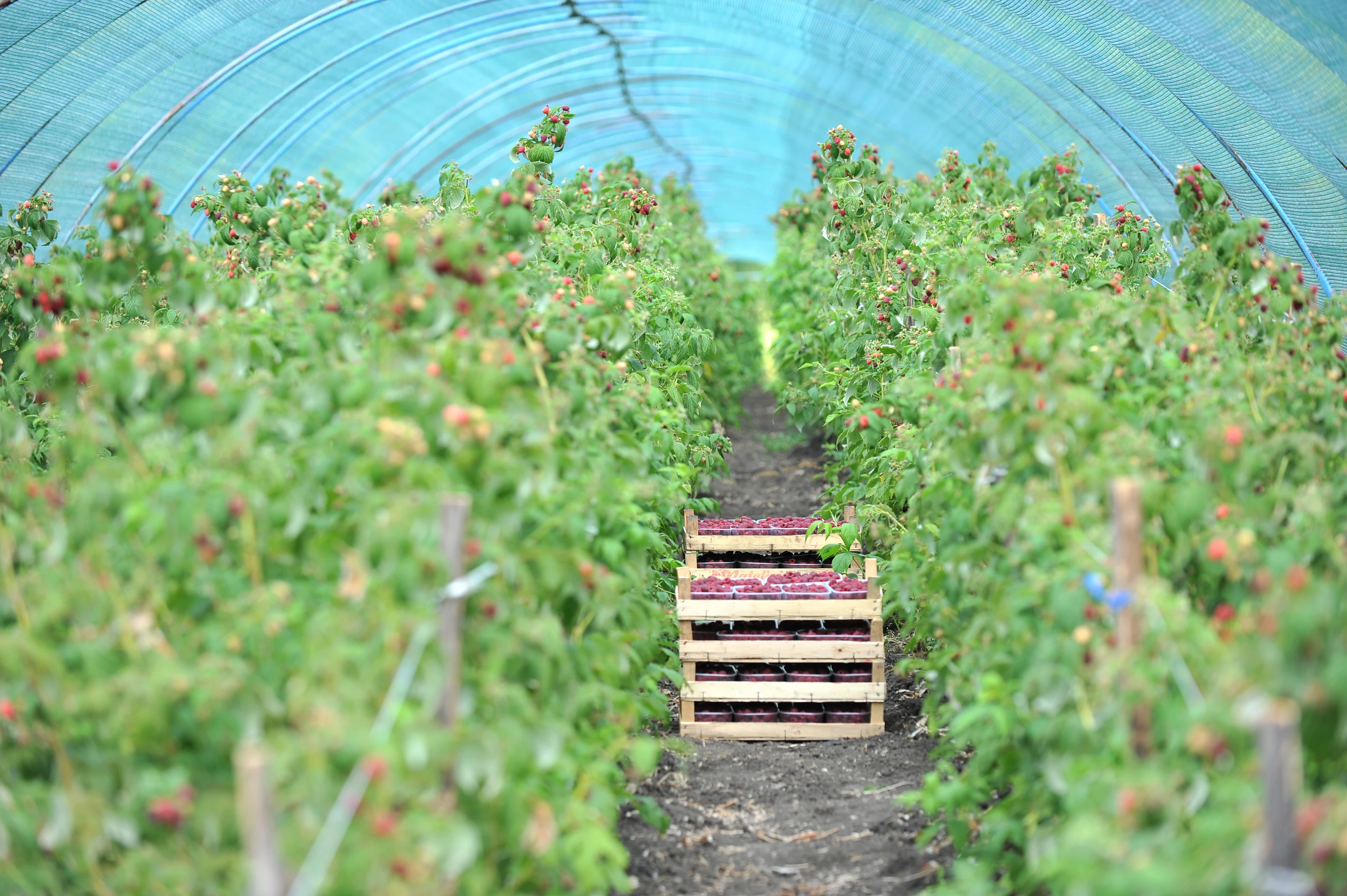
Temperature control systems for polytunnels: everything you need to know
Discover how to move beyond manual guesswork and maintain the ideal polytunnel temperature for your crops year-round.
Managing temperature in a commercial polytunnel is harder than it looks from the outside.
Temperature doesn't sit in isolation – it's directly linked to humidity, vapour pressure deficit (VPD), and disease risk.
And inside a polytunnel, those variables shift constantly. A cool morning can become an overheating afternoon before you've had a chance to react.
But most polytunnel growers are managing the variables manually (opening vents by hand, checking readings on-site, making calls based on experience) across multiple tunnels, often without reliable data to back them up.
It's labour-intensive, it's reactive, and at scale it doesn't hold up.
The good news is that the solution landscape has changed significantly in recent years.
There's now a full spectrum of options available to polytunnel growers – from basic heating equipment and standalone thermostats all the way through to integrated software platforms (like Ostara) that monitor conditions, automate hardware responses, and learn continuously to give you better information on how to optimise growing environments.
This guide maps that full landscape: what each layer of a temperature control system does, what options exist at each level, and how to work out what's right for your operation.
What is a polytunnel temperature control system?
A polytunnel temperature control system is any combination of equipment and software used to manage the temperature inside a polytunnel – with the goal of keeping conditions within the range your crops need for optimal growing, and reducing the time you spend doing that manually.
This means that in practice, "temperature control system" can mean very different things.
At one end you have a basic thermostat wired to a single vent motor. At the other, a software platform managing heating, ventilation, and humidity across multiple tunnels, with the ability to adjust settings remotely from your phone.
But across all of those options there are three core layers to how temperature control works in a polytunnel:
- Hardware: the physical equipment that acts on temperature – heating systems, fans, shading, vents.
- Monitoring: the sensors measuring conditions inside and outside your tunnels, and the software that surfaces that data as trends, dashboards, and alerts.
- Control: what decides how hardware responds. This ranges from a grower making every call manually, through simple thermostats triggering vents at a fixed threshold or timers at a set time, all the way to automated software managing conditions to a target – and at the most advanced end, systems that integrate all of the above and learn continuously from data to get more and more precise over time.
Each layer matters. The right polytunnel heater setup with no reliable monitoring is flying blind. Good monitoring data with no way to act on it quickly enough still costs you yield.
A fully integrated temperature control system – where monitoring feeds directly into hardware control – is where you can get the most out of all three.
Polytunnel temperature control hardware: heating, cooling, and ventilation
Hardware is the foundation of temperature control in polytunnels – the physical equipment that actually acts on temperature inside your tunnels.
For some growers, the first step toward better temperature control is upgrading or adding hardware. For others, the hardware is already there; the gap is in how well it's being managed – and we’ll get onto that a little later.
that actually acts on temperature inside your tunnels.
For some growers, the first step toward better temperature control is upgrading or adding hardware. For others, the hardware is already there; the gap is in how well it's being managed – and we’ll get onto that a little later.
Polytunnel heaters
Heating systems are vital in polytunnels for maintaining minimum overnight temperatures and protecting against frost in the early stages of germination – as well as extending the growing season at either end of the year.
The main options in terms of types of polytunnel heater are:
- Gas: the most widely used in commercial polytunnel operations. Thermostatically controlled and relatively straightforward to install and maintain.
- Electric: requires mains supply and is more expensive to run, but can be a practical option where gas isn't available or for smaller, targeted heat zones.
- Biomass: significant upfront capital investment, but strong ROI at scale for operations with consistent heat demand across a large growing area.
- Air source heat pumps: growing in adoption, energy-efficient, and can work well in larger operations – though typically better matched for greenhouse growing, due to the heat pumps working best in well-insulated, airtight buildings.
- Paraffin: largely declining and now mostly for hobby-scale polytunnel growers rather than commercial operations.
Polytunnel ventilation and cooling systems
Good ventilation is the most important tool for cooling polytunnels down, as well as managing humidity (and therefore pest and disease risk), and supporting CO2 exchange. In some locations, cooling systems may be needed in addition to ventilation.
The options range from simple manual systems through to purpose-engineered automated setups:
- Roller doors: the most common entry and exit point for air in commercial polytunnels – and can either be managed manually or through motorisation.
- Side vents: panels or strips along the tunnel sidewalls that can be opened to allow cross-ventilation, again can be manual or motorised.
- Roof vents: less common in polytunnels than in glasshouses, but used in some higher-spec structures as an effective way to release heat and humid air that accumulates at the apex. Again, motorised versions are available.
- Automated vent systems: purpose-built systems that integrate roller doors, side vents, and roof vents into a single coordinated setup, designed for automated or remote control. Haygrove's Total Vent is a good example.
- Extraction and circulation fans: extraction fans pull hot or humid air out of the tunnel; circulation fans keep air moving to reduce temperature stratification and humidity pockets.
- Shade cloth and netting: reduces solar heat gain during peak summer periods – typically deployed manually as needed.
- Active cooling systems: pad-and-fan evaporative cooling, fogging and misting systems, and chilled water systems all provide more aggressive temperature reduction when passive ventilation isn't enough. More capital-intensive, typically used only in high-value crop operations or regions with more extreme summer heat.
Polytunnel temperature monitoring: sensors, data, and alerts
Monitoring is the information layer – the sensors that measure what's actually happening with temperature inside your tunnels, and the software that makes that data usable for your team to make adjustments.
Environmental sensors
Environmental sensors measure conditions inside and outside the tunnel in real time, giving you the data that everything else depends on.
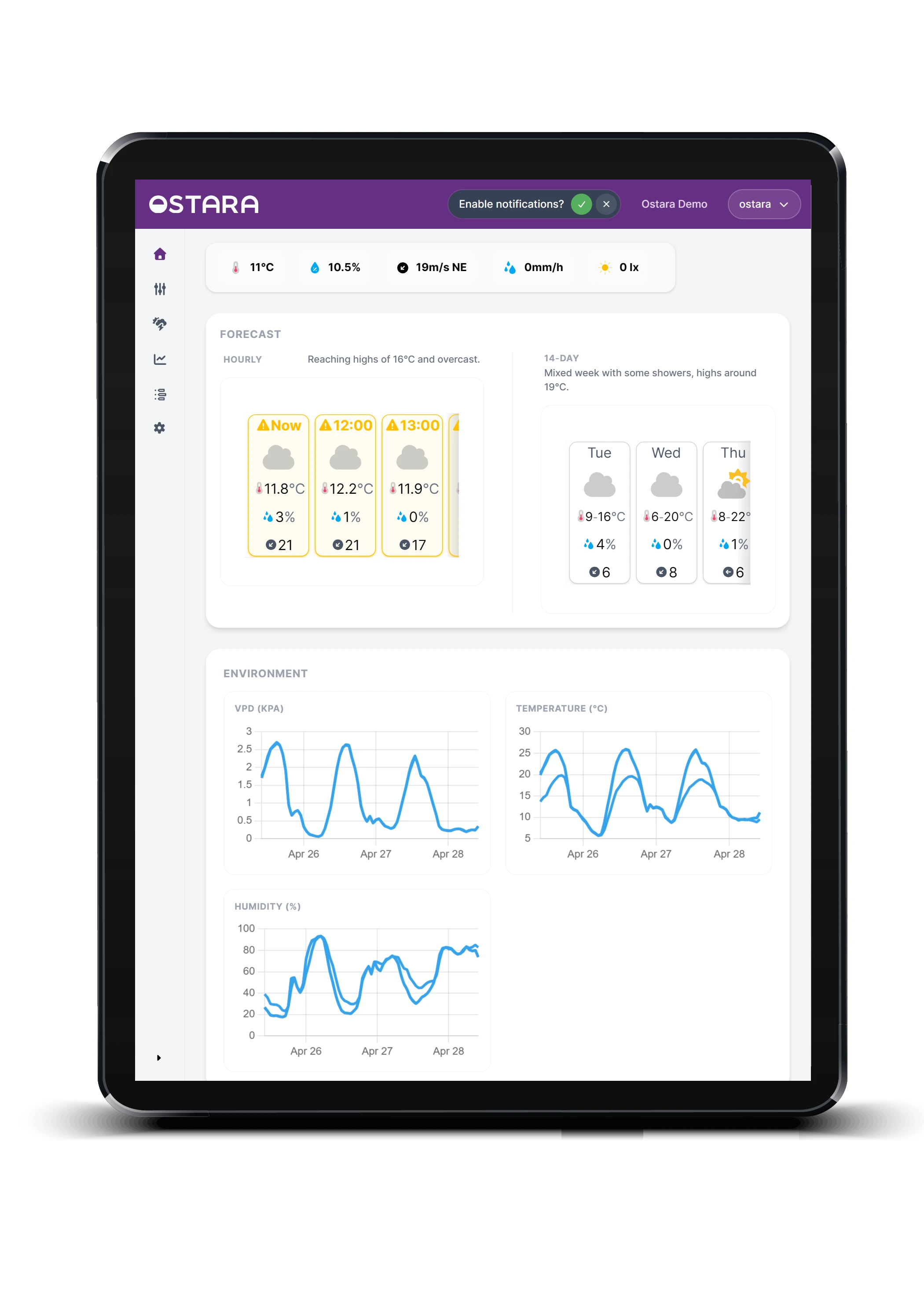
The main types for temperature management are:
- Temperature and humidity sensors: usually combined into a single unit, these are the baseline for any monitoring setup.
- VPD sensors: VPD can either be measured directly or calculated automatically from temperature and humidity readings
- External weather stations: measuring outside temperature, humidity, wind speed, and rainfall – useful context for understanding what's driving conditions inside, and for systems to suggest proactive adjustments ahead of changing weather.
Placement matters as much as the sensors themselves. A single sensor gives a single reading, which may not reflect what's happening ten metres away in a cold corner or a humidity pocket. Commercial tunnels typically need multiple sensors at different positions to get an accurate picture across the full structure.
Monitoring software and dashboards
Sensors generate data; software makes it usable. Monitoring platforms collect readings from the temperature sensors across your tunnels and surface them as dashboards, trends, and alerts – enabling you to act on what’s happening.
The main types are:
- Basic alert systems: notify you by text or email when a reading crosses a threshold; low cost and simple to set up.
- Single-variable monitoring platforms: some monitoring software specialises in one factor – temperature, in this case, but it could be irrigation, soil moisture, CO2. This is useful in isolation, but growers who build up several of these over time for different variables can often end up with data fragmented across multiple dashboards, with no clear picture of how conditions interact.
- Unified monitoring platforms: a dashboard showing all variables across your tunnels, with historical data, remote access via app, and alerts with context.
- Monitoring as part of an integrated control platform: covered in the next section – this is where monitoring feeds directly into automated hardware control, rather than stopping at the alert.
Monitoring tells you what's happening, but it doesn't act for you. If an alert fires at 2am, someone still has to physically respond.
For some growers, starting here is a practical first step: building confidence in the data before adding control and automation – but for others who already have the monitoring data, it’s more about the gap between insight and action.
Polytunnel temperature control: thermostats, timers, and software
If monitoring is the information layer on what’s happening with polytunnel temperature, control is what you do with that information.
This ranges from a grower making every call manually, through to basic thermostats, to software platforms that automate responses and learn over time. Where you sit on that spectrum determines how much time you spend firefighting and how consistently your crops stay in optimal conditions.
Manual control
Manual control means a grower or worker reading temperature conditions and deciding how hardware should respond – setting vents to open, adjusting heaters, deploying shaders. It’s dependent on someone being there to make the call, and to act on it.
The limitation is straightforward: conditions change faster than manual response allows. And because each adjustment costs time, growers tend to make fewer of them than they should — leaving tunnels in suboptimal conditions for longer than necessary.
Set-and-forget timers
A step up from fully manual control, timers trigger hardware responses at set times – opening vents at 7am, switching heating on at night. Simple to set up, and they remove the need for someone to be on-site to make the call.
The limitation is that a timer doesn't know what's actually happening in the tunnel – a timer opens the vents at 7am whether it's a warm sunny morning or a cold wet one, working on a fixed assumption, not what's actually in front of it.
For basic routines they can be useful, but they offer no responsiveness to real conditions.
Simple thermostatic controllers
Thermostatic controllers go one step further than timers: rather than responding to the clock, they respond to a temperature reading. They're available off-the-shelf from most polytunnel suppliers and are a common starting point for growers wanting condition-based automation.
The main types are:
- Single-zone thermostats: manage one zone of the tunnel, triggering hardware (vents, heaters, or both) when temperature crosses a set threshold.
- Multi-zone controllers: manage several zones independently, so each area can have its own threshold and response.
Basic thermostats are limited in what they can do. They're single-variable, reactive, and on-site only – no humidity, no VPD, no weather data, no remote access. The same threshold fires the same response every time, regardless of what else is happening in the tunnel.
Temperature control software
Control software manages hardware responses automatically, keeping temperature to pre-defined targets based on integrated monitoring readings – removing the need for manual intervention for every adjustment.
The software element enables you to manage the system remotely via a dashboard rather than physical controllers in the polytunnel – but, sophistication varies considerably depending on the platform.
The main types are:
- Single-variable: responds to temperature alone.
- Multi-variable: coordinates across heating, ventilation, fans, and other equipment simultaneously, responding to a broader set of conditions including humidity, VPD, irrigation, and so on.
- Target-based: the grower sets the desired conditions, the software works out how to reach and maintain them.
- Fully automated: the system determines what optimal looks like and manages hardware accordingly, without the grower having to define targets manually.
The key limitation here is that a system managing temperature alone can't account for the knock-on effects: opening vents to cool the tunnel also affects soil moisture evaporation rates, which in turn affects when and how much you need to irrigate.
When you build up separate platforms and processes for different variables over time you end up with a fragmented picture – multiple dashboards to make sense of, and no clear view of how conditions interact.
That's the problem an integrated climate control system is designed to solve.
Why an integrated climate control system is the best option for polytunnel temperature control
The three layers covered so far (hardware, monitoring, and control) are most effective when they work together.
Hardware without monitoring is flying blind. Monitoring without control leaves you acting on alerts manually. Control software for temperature without integrated data across all climate variables gives you an incomplete picture.
An integrated system brings all three together, so each layer informs the next.
In practice, many polytunnel growers arrive at a fragmented setup by building piece by piece – a thermostat here, a monitoring platform there, and a separate system for irrigation. It works up to a point, but you end up managing multiple dashboards with no clear view of how conditions interact.
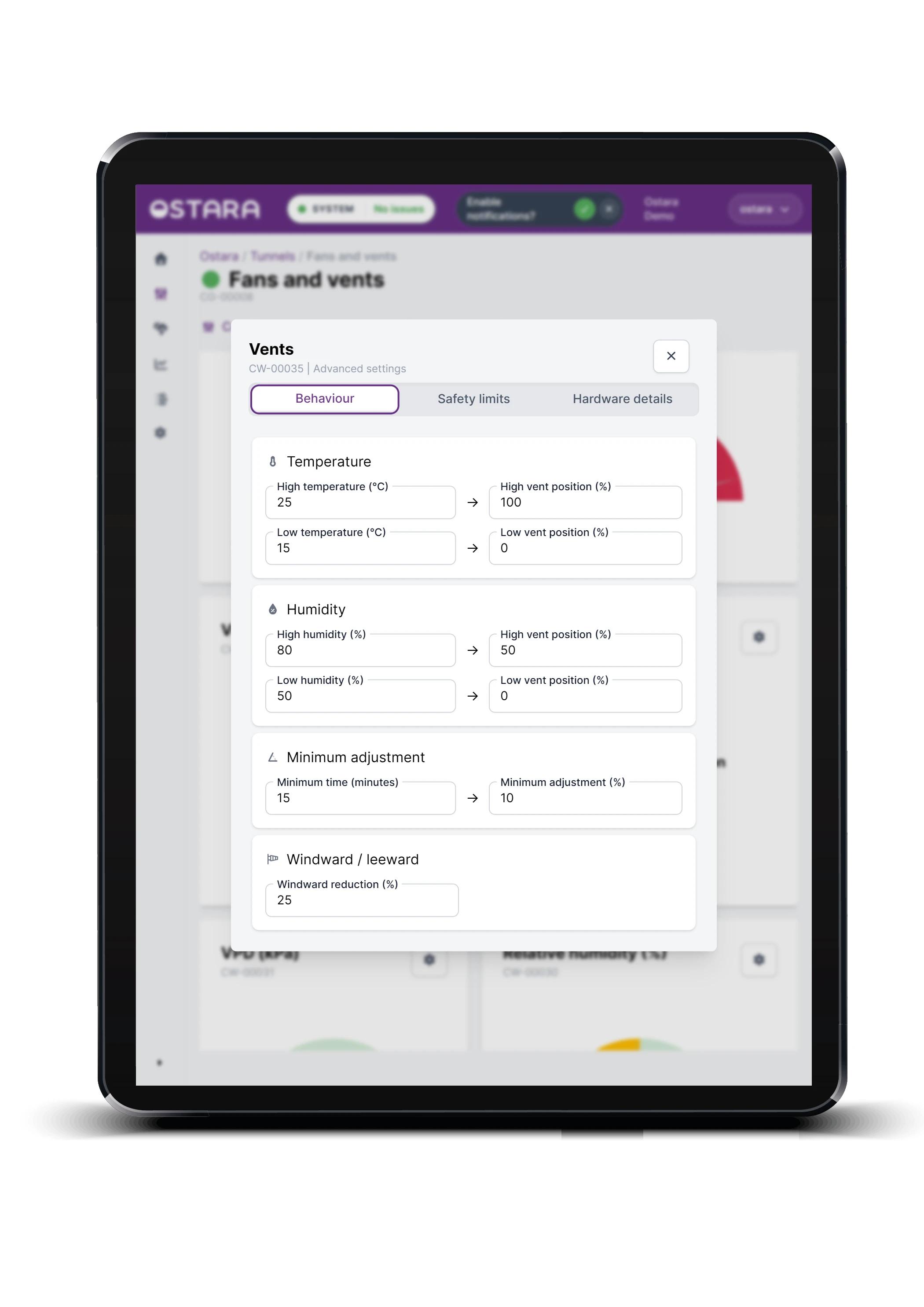
An integrated climate control platform solves this by managing the full picture in one place: real-time monitoring across all variables, automated hardware control to maintain target conditions, and continuous learning that improves precision over time.
Rather than reacting to what's already happened across several disconnected systems, you have one platform with a joined-up view of your operation.
Ostara provides this for commercial polytunnel growers.
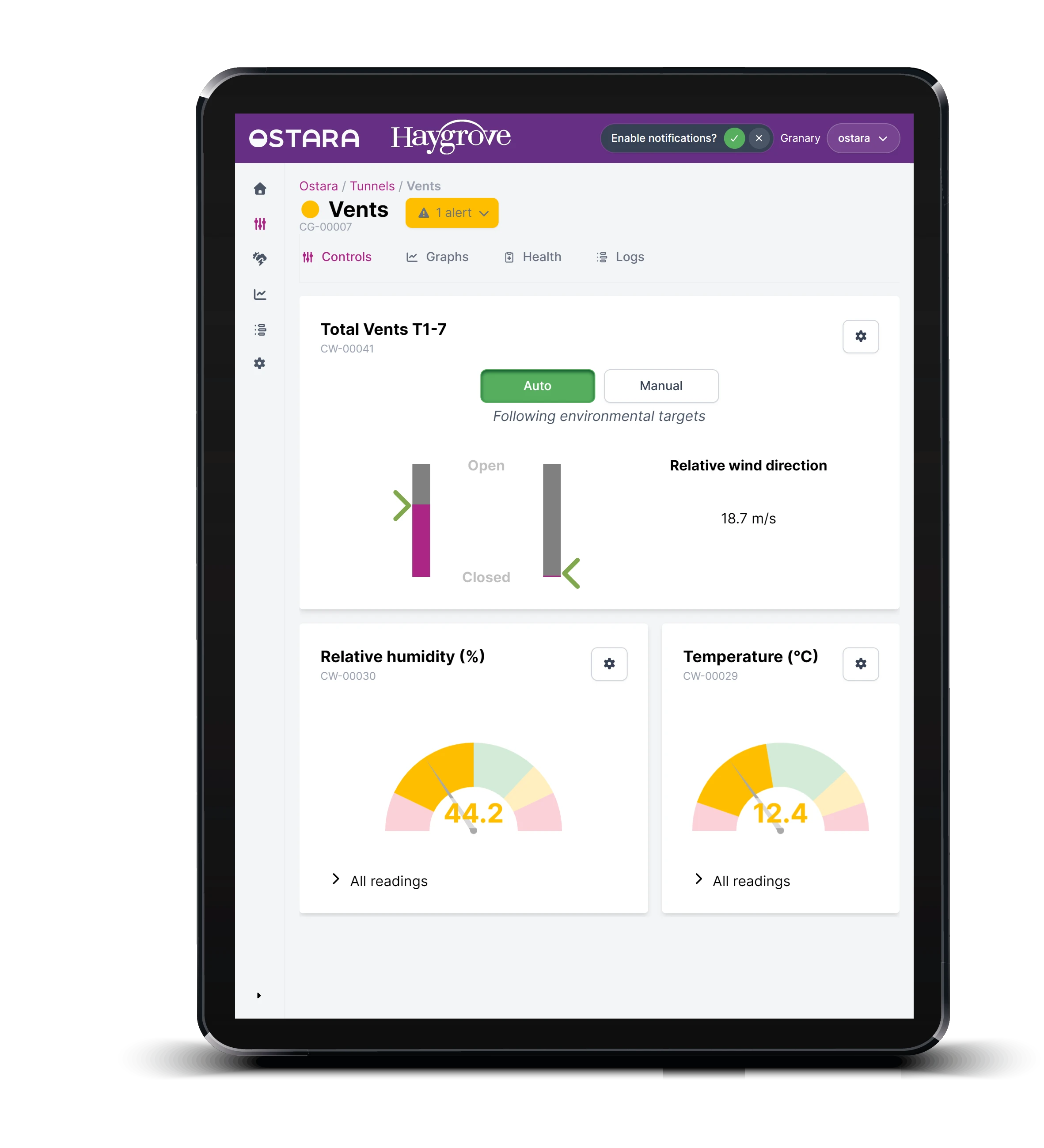
Purpose-built for polytunnel operations by a team with deep protected growing expertise, Ostara’s system combines monitoring, actionable insights, control, and automation in a single platform – going beyond temperature to manage the full climate picture including humidity, VPD, irrigation, ventilation, and lighting.
It's hardware-agnostic, so it works with equipment you already have, and suits both new builds and retrofits. Installation is straightforward, with expert support always on-hand from people who understand polytunnel growing.
The results speak for themselves. Trials with Haygrove showed that Ostara maintained VPD within the optimal range for 25% more of the time, and saved over 60 labour hours per month per hectare.
"You don't need to go and check if the tunnels are right, you just have it with you on your phone at all times." – Christi Marmandiu, International Technical Lead at Haygrove
If you'd like to see what that could look like for your operation, book a demo with the team.
How to choose the right temperature control system for your polytunnel operation
There's no universal right answer here – the best temperature control system depends on your operation, your existing setup, and what you're actually trying to solve.
These two sets of questions will help you work it out.
Start with your internal context
Before evaluating any solutions, get clear on your own situation:
- What's the primary problem you're trying to solve – overheating in summer, frost risk in winter, rapid temperature swings, or all of the above?
- Is temperature affecting yield, crop quality, disease pressure, or labour costs – and can you put a number on it?
- How many hours per week are currently being spent on manual temperature management tasks?
- How many tunnels and hectares are you managing? Do you need to coordinate across multiple sites?
- What equipment do you already have – manual vents, motorised vents, basic controllers, heaters? What can be built on, and what would need to change?
- Is this a hardware gap or a control gap, or both? Do you have the right equipment but it's not being managed well enough – or are you missing the hardware altogether?
- What's your budget, and what does payback need to look like?
- What's your comfort level with technology – do you want to start with visibility and build toward automation, or go straight to a full control system?
Then evaluate solutions and providers against these criteria:
- Will this solution still work if you add tunnels, crops, or sites – or will you outgrow it quickly?
- Does it fix the root cause, or reduce the symptoms? A basic thermostat on overheating vents might cut the worst peaks, but won't manage humidity, VPD, or disease risk – the underlying problem remains.
- Does the system manage temperature alone, or does it integrate humidity and VPD for a full picture?
- Does it provide remote access and mobile alerts, or is it on-site only?
- Does it automate to target conditions, or just trigger at a single threshold?
- Does it integrate with weather forecasts to act proactively, not just reactively?
- Is it compatible with your existing equipment, or does it require specific hardware?
- What does setup involve, and does the support team understand polytunnel operations – not just the technology?
- What evidence does the provider have from comparable operations at similar scale?
- How much manual involvement will this still require day-to-day? Is that sustainable at your scale?
Wrapping up: choose a system that solves the real problem
Choosing the right temperature control system for your polytunnel isn't about finding the most sophisticated technology – it's about finding a system that solves your actual problem, works with what you already have, and gives you the control and visibility to run your operation more effectively.
The best systems don’t just react to temperature. They manage the full growing environment – humidity, VPD, irrigation – so that when you act on a temperature problem, you're not creating another one somewhere else.
And, the best systems are also built for operations like yours, backed by people who understand polytunnel growing, and proven at comparable scale
Use the framework in this guide to get clear on your gaps before you start evaluating options – and make sure whatever you invest in fixes the root cause, not just the symptoms.
FAQs
What is the best way to control temperature in a polytunnel?
The best approach depends on your scale and what you're trying to solve, but the most effective setups combine three things: the right hardware (heating, ventilation, fans), reliable monitoring across your tunnels, and control software that manages conditions automatically to a target rather than relying on manual adjustments or basic threshold triggers. A system like Ostara that integrates all three (rather than managing each in isolation) gives you the most consistent results and the least manual involvement.
What temperature should my polytunnel be?
It depends on what you're growing. A strawberry crop, for instance, is sensitive to temperatures above 25°C, whereas leafy crops and brassicas are generally more tolerant of temperature variation. As a rough rule, most polytunnel crops need daytime temperatures in the range of 18–25°C and night temperatures above 10°C, but your specific crop requirements should always be the reference point.
How do I keep a polytunnel warm in winter?
Gas heating is the most widely used option for commercial operations – thermostatically controlled, reliable, and cost-effective at scale. For smaller setups or supplementary heat zones, electric heating can work where gas supply isn't available. Insulation also plays a role: double-skin covers and thermal screens reduce overnight heat loss significantly.
Whichever heating system you use, pairing it with temperature monitoring, weather data, and control software means you can catch drops early rather than reacting after frost damage has already occurred.
How do I stop my polytunnel overheating in summer?
Ventilation is the first line of defence: roller doors, side vents, and roof vents, though be careful of manually managed vents that are left in one position for long periods of time, as temperatures can drop significantly overnight even in the summer. Shade cloth can also be used to reduce solar heat gain before it builds up. In high-value operations or particularly hot conditions, active cooling systems like pad-and-fan evaporative cooling provide more aggressive temperature reduction when ventilation alone isn't enough.
Whichever approach you use, pairing it with temperature monitoring and control software means vents can respond automatically to conditions rather than relying on someone being on-site to make the call.
How does polytunnel climate control compare to glasshouse systems?
Glasshouse systems are typically airtight, well-insulated, and often have high-tech monitoring and control systems (e.g. Priva, Ridder, Hoogendoorn) to enable continuous automated climate management – sophisticated, but very expensive to run.
Polytunnels offer a more flexible, cost-effective growing infrastructure – but that comes with different climate management challenges. The best polytunnel climate control systems are purpose-built for that reality, delivering meaningful monitoring and automation without the complexity or cost of glasshouse systems.
Can I automate my existing polytunnel vents without replacing my whole setup?
Yes. Hardware-agnostic platforms like Ostara are designed to work with your existing equipment (vents, heaters, fans) rather than requiring you to start from scratch.
What's the ROI of automating polytunnel temperature control?
It varies by operation – crop value, current labour costs, and starting point all affect the numbers. Trials with Haygrove showed that manual vent management alone required up to 60 hours of labour per hectare per month. Across a 10-hectare site at £15 per hour, that's £9,000 a month on vent management alone – before accounting for other temperature-related labour like heater adjustments. The same trials showed Ostara maintained VPD within the optimal range for 25% more of the time, with direct implications for yield and crop quality. Most operations will see a return within the first growing season, and compounding ROI from there on.
Does Ostara support polytunnel temperature control?
Yes. Ostara is a fully integrated climate control platform – you choose which hardware and variables you want to manage, whether that's temperature and ventilation alone or the full picture including humidity, VPD, irrigation, and lighting. Ostara is also hardware-agnostic, compatible with your existing ventilation and heating systems. Trials with Haygrove demonstrated 25% more time in optimal VPD conditions and over 60 labour hours saved per hectare per month. Book a demo to see what it could look like for your operation.