Supporting Bahrain's Strategic Food Security Objectives
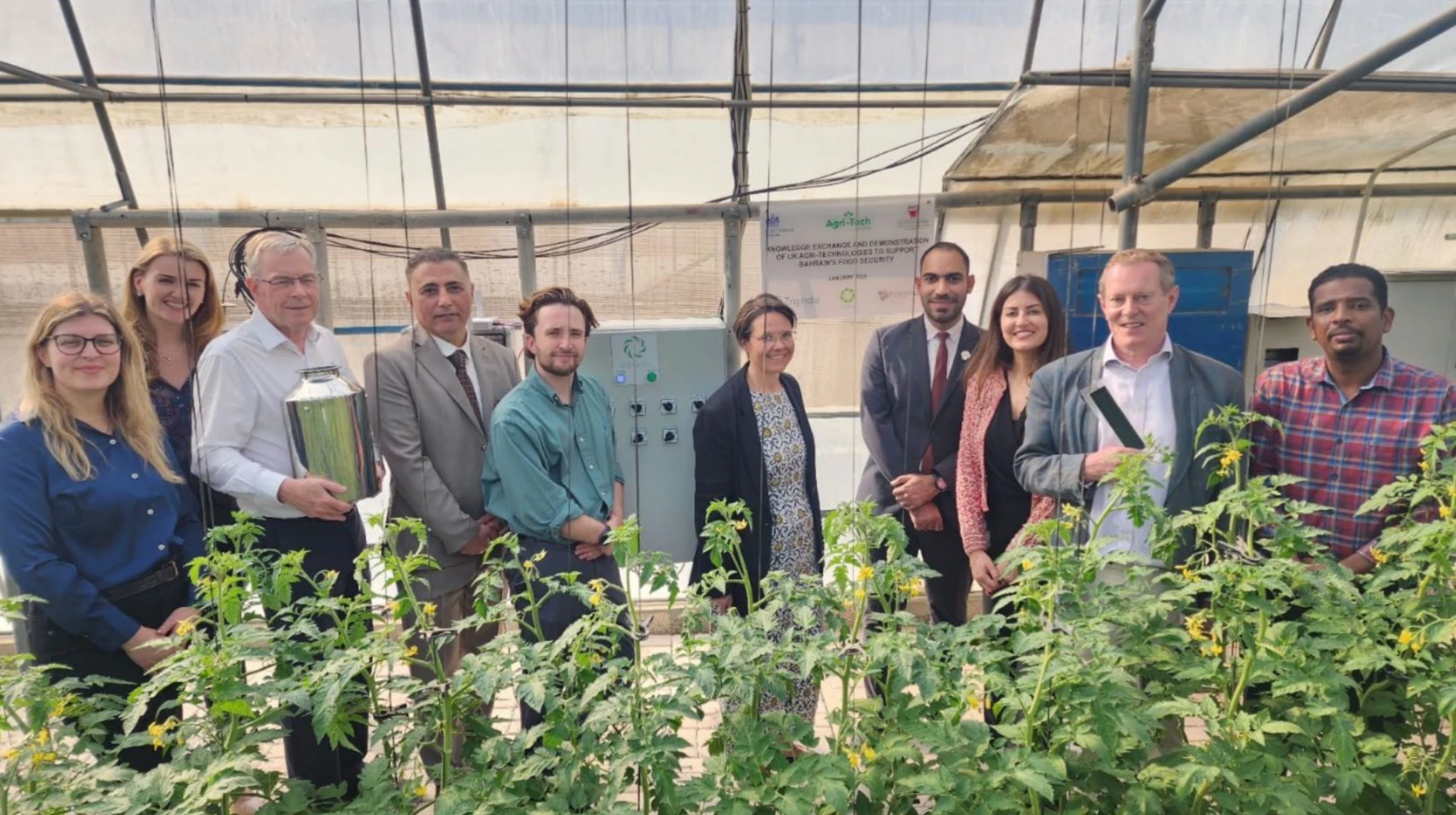
Ostara delivers sensors and an automated control at the Bahrain MMAA to provide growers with real-time data monitoring and predictive control
Introduction and Aim
The aim of this project was to work collaboratively with the UK Agri-Tech Centre, Ministry of Municipalities Affairs and Agriculture (MoMAA) and the British Embassy
Bahrain, to identify UK agri-tech solutions that could support Bahrain’s Strategic Food Security plan. Three UK agri-tech companies were selected to take part in the initiative, namely Polysolar, Ostara and Zayndu. These companies were given the opportunity to showcase their technologies at the Ministry of Municipalities Affairs and Agriculture incubator site thus establishing a physical presence in Bahrain, meet key stakeholders, and explore further opportunities for collaboration in the region.
Technology Partners
Polysolar
Company Overview
Polysolar is an established, Cambridge based, photovoltaic technology company. The company is vertically integrated, with involvement in developing next generation photovoltaic materials and processes; manufacturing semi-transparent crystalline silicon and thin-film solar PV glazing and lightweight flexible solar panels; fabricating building integrated photovoltaic (BIPV) solutions; as well as installing solar systems.
Technology Overview
Polysolar has been involved in supplying solar PV glasshouses for a number of years but has recently developed a lightweight flexible solar panel that can be applied to Polytunnels, significantly widening the market opportunity for solar in horticulture. The solar technology is based on thin-film CIGS PV made as a lightweight, flexible and durable plastic encapsulant, in 6-meter strips, allowing farmers to install over existing Polytunnels and change around the arrays as they require.
The product enables the provision of power directly into the field to facilitate automation-running irrigation pumps, lighting, robotics, cooling, etc, without the cost of having to secure and upgrade grid connections. Additionally, the generation of clean renewable energy offers the farmers a significant additional income stream through trading power back to the grid. The technology enables the combination of energy generation and food production of the same land without any loss of crop yields or solar yields.
Demonstration in Bahrain
Polysolar was invited to install its solar technology on two sites in Bahrain - at the Ministry of Municipalities Affairs and Agriculture Incubation site (Fig. 1) and on Bahrain Agricultural Development Company site.
The arrays were split so that there was 8kW on one site and 4kW on the other, with different densities of panels (10-30% shading), allowing the evaluation of the optimum arrangements and on two different crop types (Tomatoes and Salads). The mounting off the panels was also performed differently on each site due to the varying nature of the Polytunnel/Greenhouse arrangements. One site was tied down with rope, while the other was bolted to the framework. Neither site was a battery installed and both sites were grid connected. The trials in Bahrain will allow the generation of data on how the technology performs and its impact in a different climate, as well as the sales drivers and how to deliver the optimal product to the market, both in Bahrain and the wider Middle East.
Expected Impact
Polysolar currently has two ongoing trials in Brahian and thanks to the exposure from this project, is planning sales / installation on a separate private farm. The company has successfully arranged access to the data from these trials which will inform the performance of the product in the UAE and allow for further development. Additionally, Polysolar is exploring further opportunities in the UAE.
Ostara
Company Overview
Ostara is a Bristol based software company that assists commercial-scale growers to maximise productivity and resource efficiency by automating polytunnels and greenhouses. Ostara combines data monitoring and control into a single solution that enables growers to boost yields, reduce costs and optimise their facility.
Technology Overview
Designed for seamless integration with both new and existing infrastructure, Ostara’s innovative approach uses advanced control algorithms that combine real-time sensor data with weather forecasts creating the ideal environment for crop growth. Demonstration in Bahrain: Ostara was invited to install its technology at the Ministry of Municipalities Affairs and Agriculture Incubation site (Fig. 2). A range of sensors were installed in the greenhouse that measured the inside and outside environment, as well as the irrigation network. These sensors connected with Ostara’s control box which enabled the control of:
• Roof vents
• Side vents
• Cooling pumps
• Inlet fans
• Exhaust fans
• Shade netting
• Irrigation network
• Fertigation network
Following the installation, the Ostara team worked closely with the growers, providing hands-on training with their new automation system. Through practical experience, they learned how to manage every aspect of their greenhouse using the software, setting precise environmental targets to maintain optimal growing conditions for their tomato crops.
The growers were particularly excited about gaining full access to real-time data, allowing them to monitor and control their greenhouse from anywhere in the world.
Additionally, Ostara’s predictive control algorithm, which analyses weather forecasts and takes proactive measures to protect crops, will be especially valuable in mitigating the challenges posed by extreme temperature fluctuations and high winds.
Expected Impact
Since Ostara's visit, the company has made significant progress in the Middle East. Ostara is planning a return visit to scope a project with the largest commercial grower and is exploring opportunities in Saudi Arabia with support from the Ministry and Department for Business and Trade. The company has also engaged with investors to strengthen its regional position and plans to collaborate with the other UK companies, integrating Ostara with Polysolar batteries for optimal crop energy management.
Zayndu
Company Overview
Zayndu is a Loughborough based seed treatment company, that utilises cold plasma technology to create its ActivatedAir Solution. They use the raw power of nature to create a treatment that supercharges seeds, resulting in faster germination and growth, creating stronger, healthier plants.
Technology Overview
Zayndu’s ActivatedAir cold plasma technology benefits plants from the start. ActivatedAir primes seeds for faster, synchronized germination. Beyond the early-life phases of germination and seedling establishment, the ActivatedAir cold plasma treatment also has a direct, beneficial effect on plant growth. Zayndu’s cold plasma “activates” the air around the seeds, using the same principles as lightning. The plasma alters the thermodynamic equilibrium of the air, creating a cocktail of oxygen and nitrogen compounds - the very mechanisms that nature itself uses to regulate biochemical pathways.
With precise control, the technology harness nature’s own tools to improve growing results, resulting in increased yield, more plants, shorter crop cycles and more usable produce at harvest. Demonstration in Bahrain: Zayndu was invited to install its technology at the Ministry of Municipalities Affairs and Agriculture Incubation site in a fully climatic controlled room (Fig. 3). Hands on training was also provided to Ministry personnel, and project ideation was discussed. Whilst in Bahrain the technology was used on a variety of seeds that were consequently planted at the ministry site to demonstrate the effectiveness of the technology and allow hands on training.
Expected Impact
Zayndu technology was among some applied treatments to accelerate germination of Mimusops laurifolia seeds (well-known low germinating species). With the treatment with Zayndu’s ActivatedAir cold plasma technology, these seeds showed notable germination and reduced germination time compared to other treatments and control
Seed treatment with local farmers is underway to improve yields, with plans to develop a Bahrani native seed bank and developing protocols for tree seeds for establishment around Bahrain. Zayndu presented to farmers and businesses across the supply chain and toured farms in the region.
Conclusion
Three UK agri-tech companies, namely Polysolar, Ostara and Zayndu, were given the opportunity to showcase their technologies at the Ministry of Municipalities Affairs and Agriculture incubation site, thus establishing a physical presence in Bahrain and exploring further opportunities for collaboration in the region.
Training of the aforementioned technologies was delivered to Ministry personnel, and an open day allowed the showcasing of the technologies to external stakeholders.
The impact of the project is being monitored closely with each of the three technology providers, including economic, societal and environmental benefits.