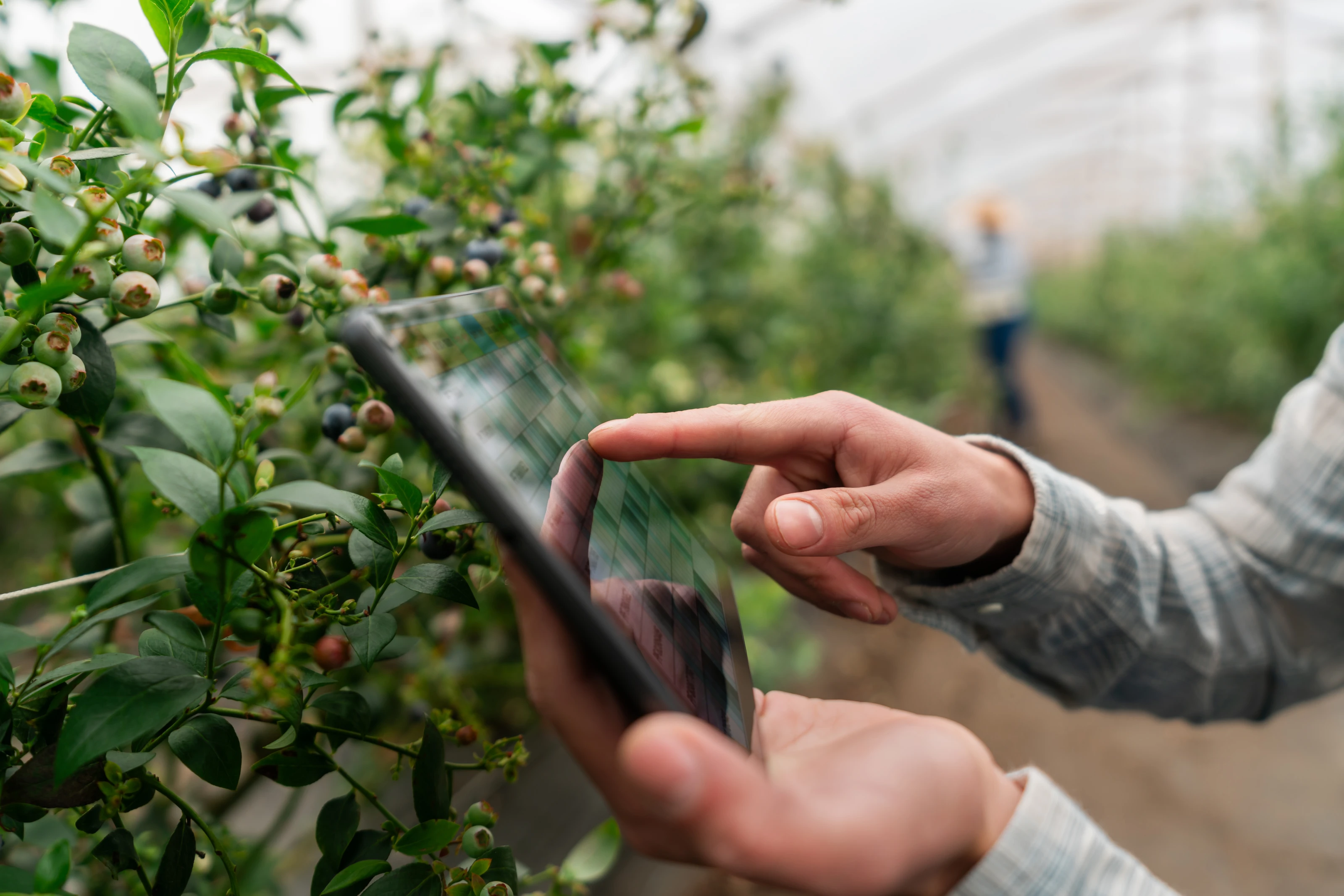
How polytunnel growers can eliminate 60 hours of manual venting labour per month with Ostara
Manual vent management demands 60 hours of labour per hectare monthly, forcing growers to sacrifice optimal conditions and yield. Ostara’s automated system eliminates this massive labour cost entirely whilst maximising time in optimal VPD.
Keeping polytunnel vents properly adjusted takes a lot of labour.
Someone has to walk the tunnels, check conditions, and physically operate the vents – and in seasons when the weather and temperatures are highly variable, that process should be done multiple times per day to keep conditions optimal.
The labour costs add up fast.
Then there's the reality of finding (and keeping) that labour – seasonal workers, temporary contracts, constant churn.
Often, these barriers of labour costs and availability mean that optimal ventilation drops to the bottom of the to list. When you do have the manpower, harvesting, crop management, monitoring soil moisture, P&D inspections, all take precedence.
Automating vent monitoring and control removes this trade-off.
Why manual vent management costs more than you think
Because manual vent management demands so many labour hours most polytunnel growers simply aren’t able to achieve optimal ventilation.
To keep airflow truly optimal requires constant adjustments – temperature, windspeed, rainfall can all change many times a day, and in an ideal world, vent position would change with them.
During trials by Haygrove, for instance, maintaining optimal conditions through manual vent management required up to 60 hours of labour per hectare per month.
Scale that across an entire operation: a 10-hectare site needs 600 hours of manual venting monthly. At £15 per hour, that's £9,000 a month. A 40-hectare site quadruples it – 2400 hours monthly, £36,000 per month spent on vent adjustments alone. And that’s just one site, many farms operate across several.
So the real cost isn't just labour hours. It's the yield you're leaving behind.
Because you can't maintain that adjustment frequency, you accept compromises.
In many farms, vents can end up staying static for days, or even weeks, whilst temperatures swing and humidity builds. Crops experience stress during germination. Pollination suffers during flowering. Conditions that encourage disease persist longer than they should.
Each compromise chips away at yield potential and Class 1 output, building up to a huge lost opportunity because of the impossibilities of keeping up with manual vent management.
How automated vent control solves the labour cost barrier
Automating vent monitoring and control removes the labour constraint entirely.
You get continuous climate optimisation without the ongoing labour spend manual management demand.
Temperature, humidity, VPD, wind, and rain are tracked in real-time. When weather changes, vents respond in seconds, protecting crops before stress happens rather than reacting after damage has started.
Plus, weather forecast integration closes vents before storms arrive – proactive protection, not reactive damage control. The vents close themselves before you’ve even thought about the damage the growing winds could cause.
And you still stay in control where you need to be, defining the settings and managing vents remotely from your phone or laptop without walking to tunnels.
There’s no more choosing between labour costs and optimal conditions.
At Haygrove's trials, automated vent control using Ostara’s climate control system delivered 25% more time with crops under optimal VPD – avoiding crop and quality losses, without requiring those 60 hours of labour per month that manual vent adjustments demand.
How Ostara delivers automated vent control for commercial polytunnel farms
Automated vent control only works if it's built for the realities of polytunnel farming: scalable across different operations, compatible with existing infrastructure, and designed around how growers actually work.
Here's what effective vent control looks like, and how Ostara delivers it:
- Complete stack: monitoring, control, and automation in one platform
- Hardware-agnostic system that works with your existing infrastructure
- Grower stays in control with safety limits and manual overrides
- Continuous optimisation through data and partnership
- Simple, intuitive interface built for farmers
- Weather forecast integration for proactive vent management.
1. Complete stack: monitoring, control, and automation in one platform
It's easy to find motorised vents or set-and-forget timers. It’s also easy to find monitoring systems that alert you when temperature or humidity hits certain levels in your polytunnels.
What's harder to find is monitoring, control, and automation integrated in one system – where real-time data enables continuous, granular adjustments that actually keep conditions optimal all season long.
It means growers often end up with multiple systems, sensors, and logins to keep track of.
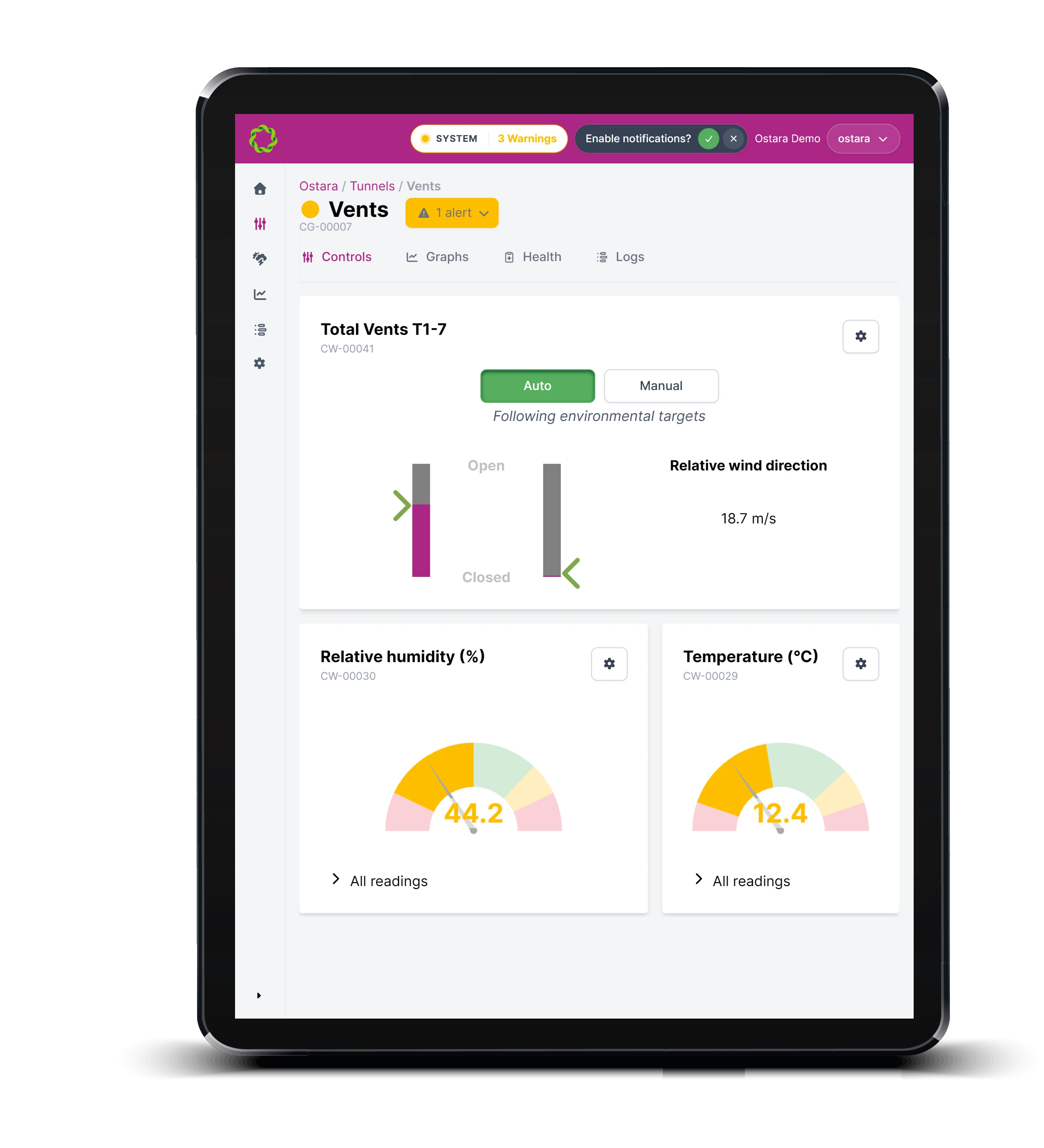
Ostara combines all three. Temperature, humidity, VPD, wind, and rain are tracked in real time. From that same dashboard, you control and automate all vents (and any other hardware) across your operation whether you’re at your desk or checking from your phone.
The vent controls are granular. Set desired behaviours for temperature, humidity, and wind: at what thresholds vents should open or close, and to what position. 27% open at 22 degrees, 60% open at high humidity, fully closed when rain exceeds 2mm per hour. There’s no binary open/closed here.
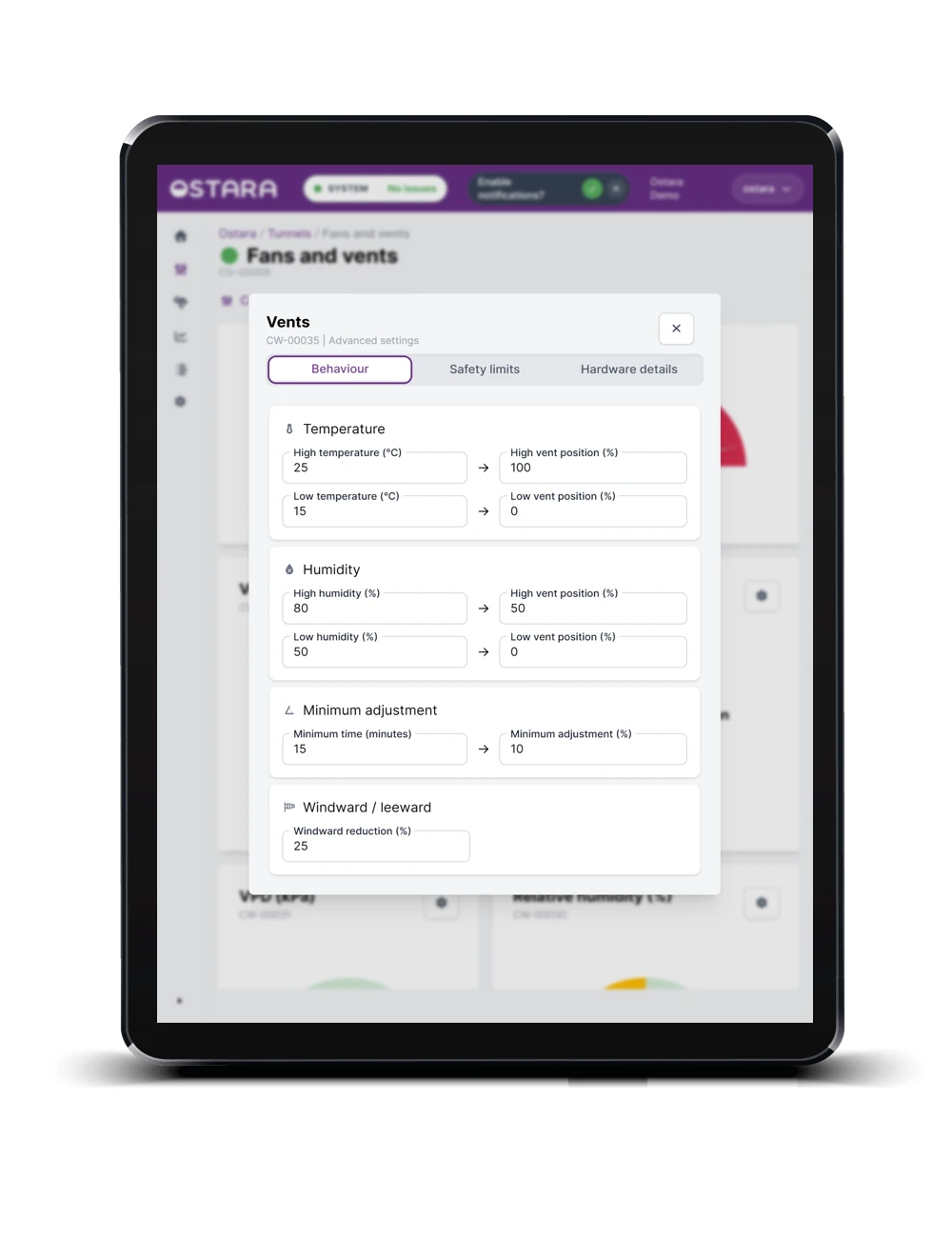
Set vents to auto, and they adjust based on the behaviours you've defined – temperature thresholds, humidity ranges, wind response. Safety limits override those behaviours when conditions get extreme: rain levels, wind limits, frost protection. You define the parameters, then the system executes them 24/7.
One system. One login. Everything you need for optimal vent management in the same place.
"Ostara has enabled us to make better decisions for the plants and maximise our return-on-investment by having roll-up venting connected to our sensors. Now Ostara might cause our vents to operate two or three times every hour to keep conditions optimal – the manual labour needed to achieve that would be a huge, huge cost." – Christi Marmandiu at Haygrove.
2. Hardware-agnostic system that works with your existing infrastructure
Replacing functional equipment just to add automation makes no economic sense.
But many vent management systems require specific hardware, forcing you to rip and replace what you've already invested in.
Ostara was built differently. The system is completely hardware-agnostic, working with your existing vent motors, whatever brand you use.

We provide an electrical panel that connects your existing hardware to the software. Inside that panel are motor drivers from Optidrive that receive signals from Ostara's software and translate them into motor movements.
Crucially, this setup also means that the system scales with your farm.
Most systems are designed hardware-first, which means each vent motor needs its own dedicated control in the software. If you have 50 vents, you're managing 50 separate controls. Add more vents, and you need more software licenses or widgets.
Ostara separates the hardware from the software completely. The electrical panel handles the connection between motors and software, so adding more vents is just a case of connecting them to the panel.
The software doesn't change: you can manage 2 vents or 200 vents from the same dashboard, with no additional software configuration needed.
It means lower upfront cost because you're keeping your existing infrastructure. No vendor lock-in because you’ve had to buy their hardware. And critically: if something breaks during growing season, any electrician can service the standard components rather than waiting for a specialist engineer.
3. Grower stays in control with safety limits and manual overrides
Ostara was designed around the principle that growers know their operations better than any algorithm.
We learned that principle from growers themselves. Early versions of our system leaned more heavily on optimising through automation. But we found that growers didn’t want the system to take over vent management completely – they wanted to understand what the system was doing and why, and they needed the ability to step in when their expertise told them conditions required a different approach.
So now the system centres around amplifying grower expertise with precision execution.
Every automated behaviour runs within parameters you set. Temperature thresholds, humidity ranges, wind response – you define what "optimal" means for your tunnels and your crops. The system executes those decisions continuously, but it's entirely predictable. You know exactly what it will do because you've told it to.

Safety limits provide another layer of control. When weather gets extreme – heavy rain, high winds, frost conditions – these limits override standard behaviours. If rain exceeds the threshold you've set, vents close regardless of temperature. You decide what constitutes "extreme" and what the system should do when it happens.
Further, manual override is always available.
Switch from auto to manual vent management with just the click of a button in the dashboard, and you take direct control of vent positions.
Physical switches on the electrical panel provide ultimate override – flip them, and you're controlling motors directly, bypassing the software entirely.
This isn't AI-managed blackbox automation where the system decides what's best without telling you. It's grower-defined automation that executes your decisions at a frequency manual labour can't sustain.
4. Continuous optimisation through data and partnership
Ostara treats vent control as an ongoing partnership, not a one-time installation.
Every operation is different – tunnel orientation, local weather patterns, crop varieties, hardware specifications. What works optimally for one grower won't be optimal for another, and what's optimal in April won't be optimal in July.
When you first get the system running, we provide default recommendations on how to optimise airflow, based on your setup – rules of thumb for minimum adjustment frequencies that balance optimisation against hardware wear and tear, informed by what works for similar operations.
Then the system starts gathering data.
Not just sensor data showing what's happening in your tunnels, but control data showing how the system is responding too – vent positions over time, adjustment frequency, how vents behave in relation to temperature swings or humidity changes.
Most monitoring systems only show you the conditions. Ostara shows you the full picture: what's happening and what the system is doing about it.
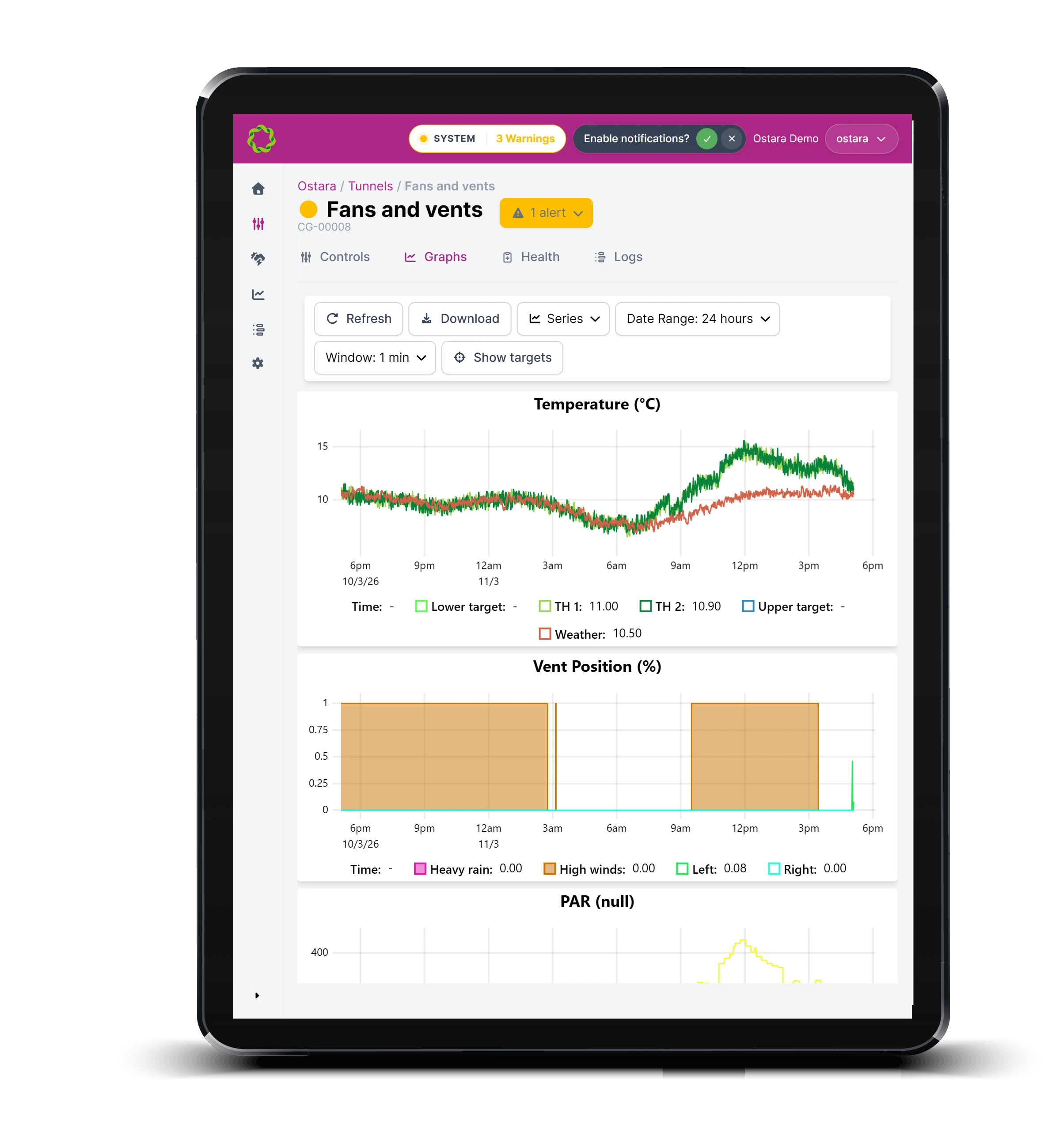
That data becomes visible in your graphs dashboard. View temperature, humidity, rain intensity, and vent positions over time – hourly, daily, weekly. Correlate vent behaviour against weather conditions to better understand how much impact your vents actually have over tunnel temperatures on sunny days versus cloudy ones.
Ostara's team of farm control experts and data scientists will then review that data with you over time – identifying patterns and spotting opportunities to fine-tune your automation settings to get you closer to your target conditions.
If slightly different parameters would reduce hardware wear by 20% with negligible impact on temperature optimisation, they'll show you the data and walk you through the trade-off.
And if you have any questions along the way the Ostara team is always on-hand to support.
You learn from the system's data. The system learns from your operation. It's a continuous cycle that builds on your expertise to keep conditions optimal as your operation evolves.
5. Simple, intuitive interface built for farmers
Most farm software is built by people who've never worked a growing season.
Dashboards are crammed with data but offer no clarity on what to do with it, and interfaces assume you're at a desk 9-5 with time to figure out every feature.
Ostara's interface has been designed in partnership with growers, iterated over five versions based on what actually works in practice.
The dashboard is intuitive to navigate, centred around auto versus manual control for each aspect of the polytunnel, with straightforward access to settings to define behaviours and safety limits from there.
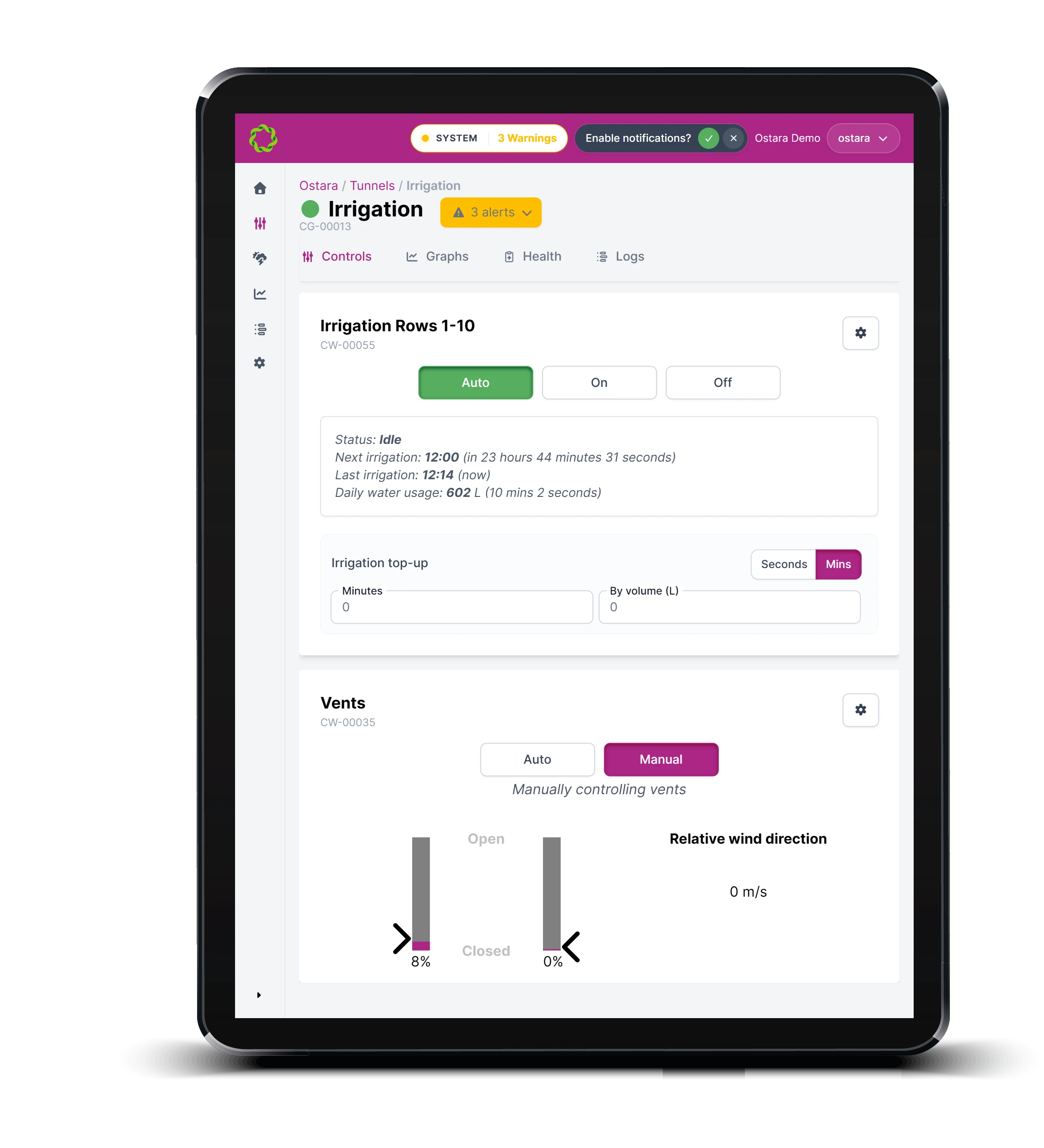
Every control group (like vents vs reservoirs) or view (like control vs graphs) is simply a different view in the dashboard.
And each group uses the same buttons and sliders. Once you understand how to manage vents, you understand how to manage everything else.
Everything is on one single login, and it’s accessible on your phone, so you can check conditions and make adjustments whilst walking tunnels or driving between sites. "You don't need to go and check if the tunnels are right, you just have it with you on your phone at all times," says Christi Marmandiu at Haygrove.
The interface works because it was built for how growers actually farm – not how software developers think farming should work.
6. Weather forecast integration for proactive vent management
Vent management is typically reactive by nature.
You see the weather changing (clouds building, wind picking up, rain starting to fall) and respond. But there’s an inevitable delay between observation and action.
When you’re managing vents manually, that delay can be huge. Even with a system like Ostara managing the response for you, there’s still a slight delay.
Which is why growers asked us to integrate weather forecasting. They needed vents to respond before conditions changed, not after.
Ostara integrates weather forecast data directly into your control system using Open Meteo's API, which connects to official forecasting services globally and offers incredibly granular weather prediction metrics.
Our weather forecast feature looks 30 minutes into the future, showing the probability of rain and wind as percentages.
You set forecast limits the same way you set all other behaviours. If there's a 30% probability of rain in the next 30 minutes, close vents by 50%. If wind probability exceeds your threshold, adjust to your specified position.
The system executes those decisions automatically, checking the weather forecast every 30 minutes, so that vents close before storms arrive, not during them.
Improve your yield without adding labour costs
Manual vent management forces an impossible choice: accept suboptimal growing conditions or spend unsustainable amounts on labour.
Automated vent control eliminates that trade-off: continuous climate optimisation without the 60 hours per hectare per month that manual management demands.
Automation doesn’t replace the value of good tunnel design or skilled growers - it simply provides an additional layer of control where it makes economic sense.
If you're ready to eliminate the manual venting constraint, speak to our team about implementing Ostara's climate control system. We'll find out more about your polytunnel operation, and walk you through how it could work for your specific setup.